Blood Sugar Breakthrough: 7 Powerful Benefits
Discover how strength training transforms blood sugar breakthrough control, boosts insulin sensitivity, and protects your metabolic health. 7 powerful, science-backed blood sugar benefits inside.
Blood Sugar Breakthrough: 7 Powerful Benefits of Strength Training

I’m Sujith John Malliyil, and if you’ve followed my work for a while, you know I don’t write “generic wellness” content. I write about what actually moves the needle. And when it comes to blood sugar, nothing has moved my needle — literally, on my own glucose monitor — quite like strength training.
For years, the cardio-first crowd convinced us that running and cycling were the only tools for managing blood sugar. They’re useful, sure. But they’re incomplete. If you want durable, day-after-day blood sugar control, the missing piece is almost always resistance training. In this guide, I’m going to walk you through seven powerful, evidence-backed ways that lifting weights — barbells, dumbbells, resistance bands, even your own bodyweight — directly improves blood sugar regulation. This isn’t theory. This is physiology you can feel within weeks.
Let’s get into it.
1. Blood Sugar and Muscle: The GLUT4 Connection
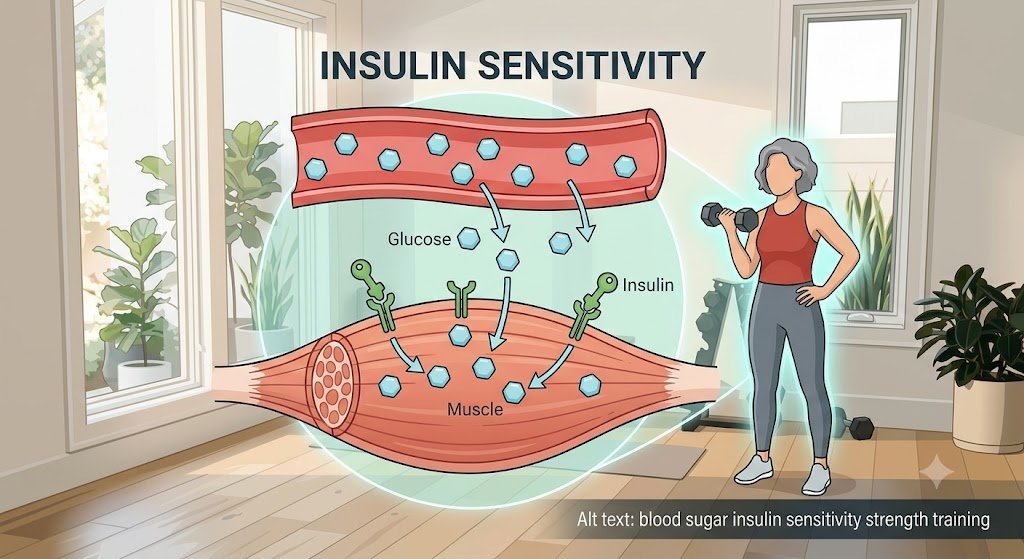
The single biggest reason strength training improves blood sugar comes down to a protein most people have never heard of: GLUT4. Your muscles use GLUT4 transporters to pull glucose out of your bloodstream and store it as glycogen. The more muscle mass you build, the more GLUT4 “docking stations” you create — and the more efficiently your body clears blood sugar after every meal.
This is why I tell every reader who’s serious about blood sugar management: don’t skip leg day. Your quads and glutes are massive glucose sinks. A single strength session can noticeably lower post-meal blood sugar for up to 24–48 hours afterward, an effect cardio alone struggles to replicate at the same intensity.
Ready to start building glucose-clearing muscle at home? Check out my top pick for a compact home gym setup → https://link.amazon/B0gQH6xqw
2. Blood Sugar Control Through Improved Insulin Sensitivity
Insulin sensitivity is the master switch behind healthy blood sugar. When your cells respond well to insulin, glucose moves out of your blood and into your muscles efficiently. When they don’t — a state called insulin resistance — blood sugar stays elevated, and over time that raises your risk of type 2 diabetes and metabolic syndrome.
Resistance training is one of the most reliable, well-studied interventions for improving insulin sensitivity, and therefore blood sugar outcomes. Studies consistently show that just two to three strength sessions a week can meaningfully improve how your body handles glucose, independent of weight loss. That’s a critical point I want to emphasize: you don’t need to drop pounds to see blood sugar improvements from lifting. The muscle-insulin relationship works on its own.
3. Blood Sugar Stability With a Higher Resting Metabolism
Every pound of muscle you build burns more calories at rest than a pound of fat — and that elevated resting metabolism plays a quiet but powerful role in blood sugar stability. A body that’s constantly using energy is a body that’s constantly pulling glucose out of storage and circulation, which smooths out the peaks and crashes that make blood sugar feel like a rollercoaster.
I’ve heard from so many readers who describe their blood sugar swings as “the 3pm crash” or “the after-lunch fog.” In my experience, and in the research, building lean muscle through consistent strength training is one of the most underrated fixes for exactly this problem. Stable blood sugar means stable energy, stable mood, and far fewer cravings.
4. Blood Sugar Regulation via Visceral Fat Reduction
Visceral fat — the deep abdominal fat that wraps around your organs — is one of the biggest drivers of poor blood sugar control. It releases inflammatory compounds that directly interfere with insulin signaling. The good news? Strength training is remarkably effective at reducing visceral fat, even in people who don’t see big changes on the scale.
As visceral fat drops, blood sugar regulation tends to improve almost in lockstep. This is one of the reasons I recommend strength training over pure calorie restriction for anyone focused on long-term blood sugar health — the type of fat you lose matters just as much as how much you lose. Combined with a sensible diet, resistance training targets the exact fat tissue most responsible for blood sugar dysfunction.
5. Blood Sugar Balance and Long-Term Diabetes Prevention
Let’s talk long game. Poor blood sugar control today is the number one predictor of type 2 diabetes tomorrow. The CDC and countless clinical bodies point to resistance training as a core pillar of diabetes prevention, alongside diet and cardiovascular exercise. You can read more from the CDC’s official diabetes prevention resources, which reinforce exactly what I’ve seen anecdotally and in the literature: blood sugar control isn’t a one-time fix, it’s a lifestyle built on consistent strength work.
What I love about strength training for blood sugar balance is that its benefits compound. Each session doesn’t just help today’s blood sugar readings — it builds the muscular and metabolic infrastructure that protects you five, ten, twenty years from now. Prevention beats management every time, and prevention starts in the weight room.

6. Blood Sugar Management Beyond the Gym: The Hormonal Ripple Effect
Blood sugar doesn’t live in isolation — it’s deeply tied to cortisol, growth hormone, and testosterone, all of which strength training influences. Chronic stress and poor sleep spike cortisol, and elevated cortisol is a well-documented driver of high blood sugar, even when your diet hasn’t changed at all.
Resistance training helps regulate this entire hormonal cascade. Post-workout, you get a healthy, short-term cortisol response followed by improved recovery hormones — a pattern that, over weeks, supports better blood sugar control around the clock, not just during your workout window. This is the “beyond the gym” effect I talk about constantly: your blood sugar improves at 2am while you sleep, not just at 2pm while you lift.
7. Blood Sugar Consistency: Building a Sustainable Strength Habit
Here’s the truth nobody wants to hear: the best blood sugar intervention is the one you’ll actually stick with. I’ve tested elaborate protocols, extreme diets, and every glucose “hack” on the internet. None of them beat the simple, boring consistency of two or three strength sessions a week, done for years, not weeks.
Sustainable blood sugar improvement isn’t about a perfect program. It’s about repetition. Pick compound lifts — squats, deadlifts, presses, rows — that recruit the most muscle mass, and therefore create the biggest blood sugar impact per session. Progressive overload, done consistently, is quietly one of the most powerful blood sugar management tools available to anyone, at any age, with any equipment level.
How to Start a Blood Sugar-Friendly Strength Routine This Week
I get this question constantly: “Sujith, I believe the research, but how do I actually start?” Fair question. You don’t need a gym membership, a coach, or hours of free time to start improving your blood sugar through strength training. Here’s the simple framework I give every beginner reader.
First, pick three total-body sessions per week, with at least one rest day between them. Each session should hit your legs, back, chest, shoulders, and core — because the more total muscle you recruit, the bigger the blood sugar benefit per session. A simple squat, a push movement, a pull movement, and a hip-hinge like a deadlift or hip thrust covers almost everything you need.
Second, prioritize progressive overload. Your blood sugar doesn’t respond to the same stimulus forever — your muscles adapt, and so must your training. Add a little weight, a rep, or a set every one to two weeks. This progressive stress is exactly what keeps GLUT4 transporters upregulated and your blood sugar response improving over time, rather than plateauing after the first month.
Third, train close to a meal when possible, ideally within one to two hours after eating. This timing lets your muscles act as an immediate glucose sink right when blood sugar would otherwise be climbing. It’s a small scheduling tweak that meaningfully amplifies the blood sugar benefits you’re already working hard to earn.
Blood Sugar Myths I Want to Clear Up
Before we wrap up, let me address a few blood sugar myths I see repeated everywhere. Myth one: cardio is superior to strength training for blood sugar control. It isn’t — they’re complementary, but muscle mass is the bigger long-term lever. Myth two: you need to train for hours to see blood sugar benefits. You don’t. Twenty to forty minutes, three times a week, is plenty to shift your blood sugar trajectory in the right direction. Myth three: strength training is only for younger people or athletes chasing aesthetics. In reality, some of the most dramatic blood sugar improvements I’ve seen reported come from readers in their fifties, sixties, and beyond who started lifting specifically to protect their metabolic health.
Clearing up these myths matters because misinformation is often the biggest barrier standing between someone and genuinely better blood sugar control. Once you understand the real mechanism — muscle as a glucose-clearing organ — the “why” behind every strength session becomes obvious.
Final Thoughts on Blood Sugar and Strength Training
If there’s one thing I want you to take away from this, it’s this: blood sugar control is not just a diet problem — it’s a muscle problem. Every rep you do, every set you finish, is a direct investment in better blood sugar regulation, better energy, and a lower long-term risk of metabolic disease.
Start where you are. Two sessions a week. Compound movements. Progressive overload. Give it eight weeks, and I’d bet your own glucose readings — like mine did — will tell the story better than any article can.
I know how overwhelming health advice can feel when every article promises a different miracle fix for blood sugar. My goal with this piece was the opposite of that — I wanted to hand you one mechanism, backed by real physiology, that you can trust and act on immediately. Strength training won’t replace medical care, and it isn’t a substitute for a conversation with your doctor if you’re already managing diagnosed blood sugar issues. But as a foundational habit, nothing I’ve tried has delivered more consistent blood sugar returns for less time invested. That’s the honest, no-hype verdict, from one professional blogger who tracks his own numbers every single week.